www.
revolution
culture
journal.
com

Dedicated to Intellectual Disobedience and the Pursuit of Understanding, the Last Bastions of Hope

Front Page    Politics & Policy     Technology    Media    Books    Cinema    Environmental Design    Music    Reviews    Art    Fashion    Features    Science    

 About    Resources    Contact    Join List   Resources  ◄►Election 2012  Economy  ►Occupy Wall Street 

 Volume 1-2012                                                           

HOT THIS WEEK

FEATURES CURRENTLY AT RCJ

Are You A Slave? A Brief History of the Subject Suggests "Probably"

Moses, Wall Street, Human Nature and Grover Norquist

Concepts of Resistance - The RCJ Provides a Road Map for the OWS Movement

Lance Henriksen - World's Greatest Actor in Reflective Mode

Conspiracy - A Hitch-Hiker's Guide to the New World Order

Elections 2012

What Does it Take to be President?

Rating the U.S. News Readers

The Antidote to Michelle Bachman

Ship of Fools - Why Won't We Save Ourselves?

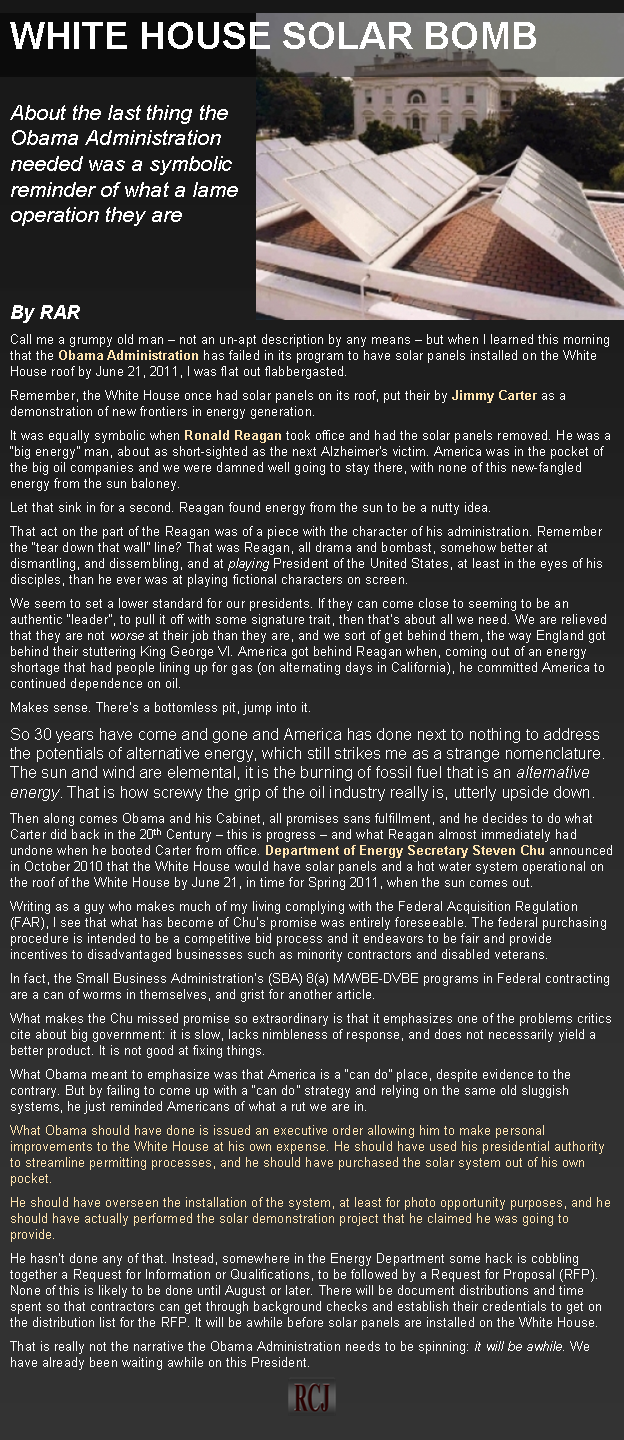
White House Solar Bomb

What Is Happening to Us?

The Cloud - What It Is

Background on Afghanistan

Economics 101

Global Economic Risks

Islamic Definition

Middle East

Second Amendment Remedies

Sam Broussard - Republicans

Treason

Why All the Zombies?

Gun Rights

Leadership Chronicles


FEATURED BLOGGERS

Is Belief In God a Sign of Weakness?

Rick Alan Rice - Publisher of RARWRITER.com and the Revolution Culture Journal.

No, but it may be a signal for help, and not necessarily in a bad way.

God is a construction of peoples’ need to have an organizing influence in their lives, standards to live by, and some reason to carry on. In all of those ways, God and everything that comes with it – the afterlife, sense of well being and spiritual comfort, and purpose in all things – is truly helpful to people, as various studies have seemed to indicate. Belief is powerful, almost regardless of its details.

That God, and the belief therein, is a signal for help is endemic to the genesis of the subject, if you will pardon the pun.
Read Post - Comment


Letter to Conservatives: The Party of Wealth – Theirs
 

Sam Broussard - Writer, Songwriter, Musician, member of Steve Reilly and the Mamou Playboys

 www.sambroussard.com

Three of the front runners for the Republican nomination are now just memories, pundit fodder: Huckabee and Trump, and Palin recedes into political tinnitus. But the retiring of all three has one thing in common, and it’s money. Huckabee just bought a huge house in Florida and is enjoying his status and salary at Fox News. Trump is more at home on his reality show. And Palin is enjoying both Fox money and reality TV and will probably be the next Oprah Winfrey, although she’ll never get more than twenty percent of the viewers because only that percentage of Americans can identify with her spunky pride in her ignorance. And yes, she’s pretty.

Read Post - Comment

_______________

We Need A New Party!

Kenny Lee Lewis - Member of The Steve Miller Band, Guitarist/singer/songwriter, Novelist/screenwriter' www.kennyleelewis.com, www.stevemillerband.com

I am a rock star. Ok, ok, I am in a band with a rock star.  I am also a husband, father of three daughters, and a small business owner who pays his taxes like anyone else. I never got into politics until the last election and wrote and produced a non-partisan PSA video for Comcast called “Get Out and Vote” to help assuage voter apathy throughout this ailing nation. I didn’t vote for either one of the major candidates in 2008. I am all about trying to rally everyone to start voting again so we can possibly support a third political party that makes sense. If we can educate and get people out to the polls again, I believe that there could be a groundswell of voters who could turn the tides in future elections.
We need a party “by the people and for the people”. As corny as that sounds, it is a precept that our nation was founded upon and if we are to lift up and resuscitate this
suffocating political system, we are going to need a leader who actually leads rather than folds like a cheap stroller just to please his parties’ special interests.

(Use the link below to read Kenny's entire post (© Kenny Lee Lewis, 2011 - All Rights Reserved).

Read Post - Comment

____________

The RCJ Posts Issues Questionnaire on Obama - Obama 2012 – Where Do You Stand?

Rick Alan Rice - Publisher of RARWRITER.com and the Revolution Culture Journal. He is also proprietor of A&E/IT Consulting firm Rick A Rice Consulting.

The Revolution Culture Journal (RCJ) invites you to participate in a little experiment to help us understand public perception of President Barack Obama, particularly as it relates to enthusiasm for his re-election in 2012.

We have identified 34 issues in U.S. foreign and domestic policy and devised a scale to determine how well respondents feel President Obama is doing with each. Use this link to go to the questionnaire.

Read Post - Comment

____________

Bechtel’s Long-Term Commitment to Nuclear Disaster

Rick Alan Rice - Publisher of RARWRITER.com and the Revolution Culture Journal. He is also proprietor of A&E/IT Consulting firm Rick A Rice Consulting.

Somehow the idea of using nuclear fission, and eventually nuclear fusion, to boil water, produce steam, drive turbines and produce direct current electricity has found its way back into the list of acceptable alternatives as an environmentally friendly solution. This bit of Houdini depends entirely on comparison to power generation through the burning of coal, which produces carbon emissions and is a primary contributor to rising levels of greenhouse gas (GHG) in our choking environment.

Read Post - Comment

___________

Applying Grover Norquist to Corporation Intellectual Starvation

Rick Alan Rice - Publisher of RARWRITER.com and the Revolution Culture Journal. He is also proprietor of A&E/IT Consulting firm Rick A Rice Consulting.

In my career as a consultant, I have all kinds of opportunities to interact with different personality types at different levels of organizations. Some of these are of the kind that might make others feel that life is not worth living, but the advantage of consultancy is that my involvements are focused, short, and generally sweet, and then I leave the office dramas behind for a quick dip into the next kiln of opportunity. I am like a merry mercenary in that way, unexposed to the daily grind of the organizations with which I work.

Staff people, on the other hand, are subject to hierarchical structures and personality profiles, and their critical path issue is: a) whether or not to stay in the roles they are in, given the odds of rising up to a more satisfying position within the organization; or b) to cast their fates to wind, which is the job market.

So much of life happens at the initial sell-in.

Read Post - Comment

___________

Appointment with Disaster - Republican Domestic Policy

Rick Alan Rice - Publisher of RARWRITER.com and the Revolution Culture Journal.

While the rich are enjoying tax breaks they have no need for and U.S. corporations are holding on to record profits, padding their accounts to ensure that this is not their rainy day, but doing little to further the employment and domestic security needs of United States citizens, word comes that we are running out of money to provide help for a growing population of homeless (see the Huffington Post on this date).
Read Post - Comment

___________


Welcoming the Arab Street to U.S. Foreign Policy

Rick Alan Rice - Publisher of RARWRITER.com and the Revolution Culture Journal.

I was all set to thank the progressive Arab world, or at least the 25 percent of it that is situated in Egypt, for taking charge of U.S. foreign policy and forcing it to make sense. Then those pro-Mubarak thugs showed up and shocked the global community back to reality.
Read Post - Comment

___________


Why Your College Student Can't Read, Write or Even Think

Rick Alan Rice - Publisher, Writer, A&E / IT Consultant

Back a hundred years ago, when I was in college, all the guys who were doing the best in the classes I took all seemed to be Viet Nam veterans going to school on government grants. They tended to stand out because they were older and far more experienced than their classmates. It seems unlikely that they were brighter, but they were fundamentally different in terms of focus and perspective in ways that seemed obviously helpful to them.
Read Post - Comment

___________


GOOD VISITS: Sites
Cracked.com


  ENVIRONMENTAL DESIGN

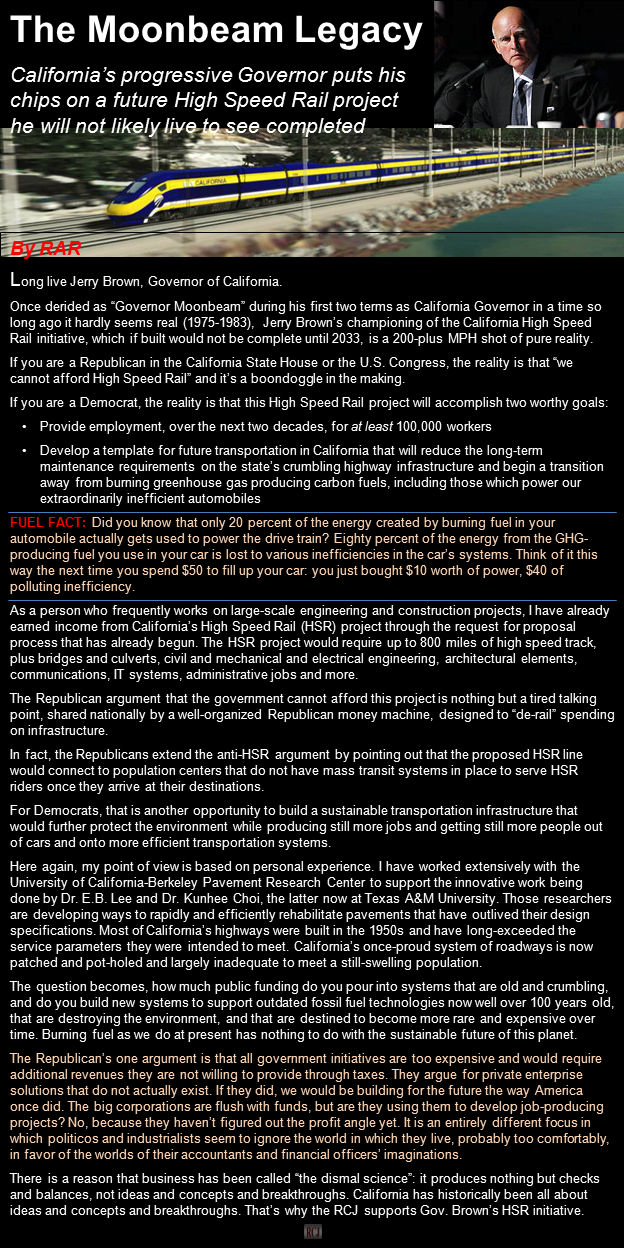
Bracing for the Big One

Heavy rains, floods, waterborne disease and infestations of insects... The National Resources Defense Council readies for rocky times ahead...


___________
 

______

Inverted Skyscraper

Is Mexico City's 65-story Underground Model a Good Idea for City Planning?


_______________


__________________
 

_____________________
 

________________________
___________
America: Growing Stupid

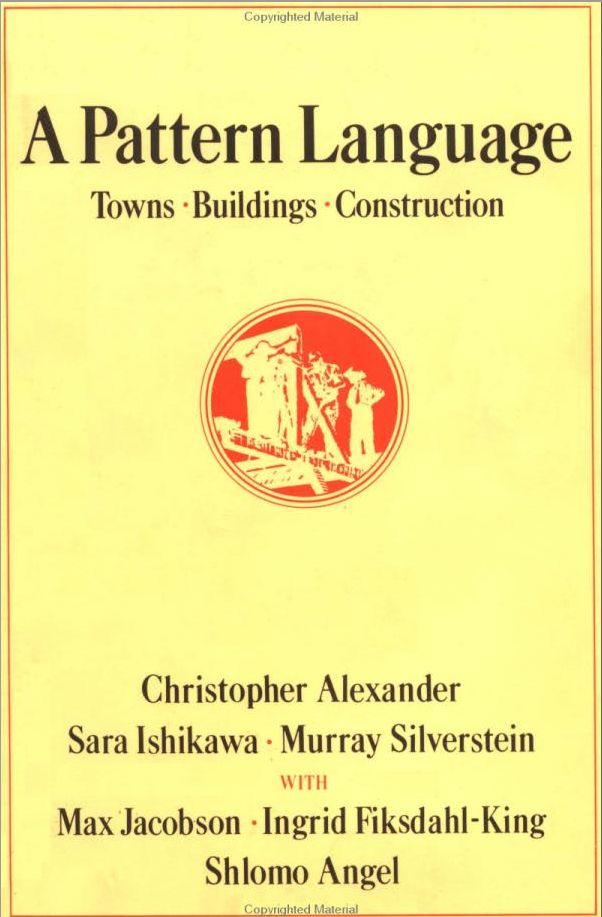
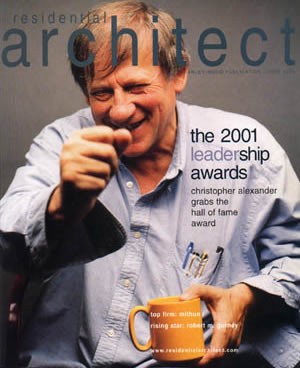
Back in 1977, the Center for Environmental Structure at the University of California-Berkeley, published the second of a three-volume series on "environmental planning." It is a dandy of a textbook titled A Pattern Language: Towns, Buildings, Construction, and it was written by a committee of academic planners and architects consisting of "Architect and Mathematician" Christopher Alexander (pictured below on the cover of Residential Architect magazine) and all the other people listed there on the right.

Here is the way the book is described at Amazon.com: "...published... to provide a 'working alternative to our present ideas about architecture, building, and planning,' A Pattern Language offers a practical language for building and planning based on natural considerations. The reader is given an overview of some 250 patterns that are the units of this language, each consisting of a design problem, discussion, illustration, and solution. By understanding recurrent design problems in our environment, readers can identify extant patterns in their own design projects and use these patterns to create a language of their own..."

Here is Christopher Alexander himself, stating his point of view most eloquently in an interview that can be read in full at http://www.katarxis3.com/Alexander.htm :
"My interest is in buildings. And I'm a scientist insofar as I try to understand what's going on in buildings, in a reproducible, accurate fashion, and try to tell the truth about it. I'd say that the principal thing that has helped me to thread my way through this rather incredible briar patch is trying to tell the truth about what is really going on - when you're in a building, when you go into a building, when you come out of a building, when you use a building, when you look at a building, when you look out the window of the building, and so forth.

And I'd say that the biggest problem with 20th century architecture was that architects became involved in a huge lie. Essentially what happened at the beginning of the 20th century was really a legacy of the 19th. New forms of production began to be visible. And in some fashion artists and architects were invited to become front men for this very serious economic and industrial transformation.

I don't think they knew what was happening. That is, I don't think in most cases there was anything cynical about this. But they were actually in effect bought out. So that the heroes of, let's say, the first half of the 20th century - Le Corbusier, Mies Van Der Rohe, Gropius even - a very nice man, by the way - were brought on board in effect to say, OK, here's all this stuff happening, what can you do with it? Let's prove that it's really a wonderful world we're going towards. And instead of reflecting on questions about, well, what was it that was going to be wonderful about this world - from the very beginning, the architects became visual spokesmen, in a way to try to prove that everything was really OK. Not only that it was really OK, but somehow magic.

You know, there was this phrase, elan vital, which was bandied about a lot in the middle years of the century, and in the early years of the century as well - of, there's something incredible happening here, we're part of it, we're reaching forward. But all of this was really image factory stuff. And what they didn't know about the late 20th century was only known to a few visionaries like Orwell and others who could actually see really what was going on.

I don't think this is a very flattering view, and I suppose architects would reject it, angrily. But I do think it's true."

____________________________________

Thirty-one years have passed since Alexander and his crew published that landmark book, and in the interview referenced above one can hardly sense frustration in the great thinker regarding how little it has all mattered.

The Center for Environmental Structure has branched out to have chapters throughout the world, and Alexander has gone on to write other books (e.g., Notes on the Synthesis of Form, A City is Not A Tree, and The Nature of Order) and become a "star" in his rarified field of academia. In fact, Alexander's centers have had what impact they have had in the nether reaches of the developing world, where things are built from scratch and can most easily be matched up with Alexander's concepts in planned development. Central to that concept is the idea of many small independently operating central communities in which people live, work and relate. Those are all primitive designs to begin with, culled from a retrospective view on English villages of the 17th, 18th and 19th centuries. They are naturals for third world development and it is heartening to imagine "invisible worlds" out there on the global landscape being developed in ways that sustain resources and develop greater and more advanced senses of local connectedness.

Do you see the irony here? Alexander's focus with A Pattern Language was to create a framework for mounting arguments against a tidal wave of corporate intellectualism in which the focus was on differentiating power, size, elitism, exclusivity and, most of all, conspicuous consumption. The academics never had a chance against sex that charged.

I suppose you could say that, maybe viewed from space, America has developed along Alexander's blueprint for urban growth but at a scale that turns the advantages of regional connectedness on its ear. They say "all politics is local" and that's because all economics is local, too.

Development in the United States has been of a horizontal nature, with cities spreading to suburbs connecting to other suburbs and to other cities, because there has been available land that could be had for less than would be required to build vertically within established centers, not that his would have been a great idea either.

Developments - residential and commercial - are intensely political things involving the approvals of governmental and quasi-governmental entities, and the machinations of antagonistic competitors, interest groups, and activist protesters. This ratio of developers to stakeholders magnifies dramatically in the most mature markets, like the San Francisco Bay Area, so usually it has been easier for deal makers to build their developments along highway corridors that connect their "projects" to important commercial centers, in the process gaining more attractive terms from county agencies eager to boost the economies of their outlying regions.

It has all made a logical sort of sense, as long as "we" had two critical resources in enviable quantities: time and money. Time to cover long commutes that add 5 to 15 hours to the five-day work week, and money to cover the costs of driving, parking and maintaining your car.

Other than for the obscenely wealthy, neither time nor money are renewable in any guaranteed way. There, in fact, is the rub: the desire to "develop" one's way into the obscenely wealthy class, thereby elevating into a reality in which comfort renders common concerns more or less trivial, drives ambition. This is the real engine behind America's obsession with "growth," the holiest grail among those comprising the American Dream.

Developers and planners in the United States, especially over the past 60 years, haven't been thinking much beyond the short term impacts of a limited range of considerations, mostly focusing on the benefits of increased revenues, public and otherwise. What they haven't focused on are the things that Alexander and his cohorts have been emphasizing, which is environmental sustainability in all of its parts, including the quality of human life. - RAR

Poverty In the Suburbs - Nowhere to Run!

In 2008, a joint study of the Federal Reserve's Community Affairs department and the Brookings Institution Metropolitan Policy Program revealed that the poverty profile in the U.S. has spread from concentrations in rural and inner-city areas to include the nation's suburbs.

The report on the study was released at the close of "Black Friday's" news day - "Black Friday" being the day-after-Thanksgiving shopping day, the busiest single shopping day of the year, when the nation's retailers take in 40 per cent of their year's income and hope to move their accounts into "black" ink.

The study was prepared for a special meeting of the Fed to discuss the issue of "concentrated poverty."


Traffic Study on Benicia, CA

Driving, Even Walking, Can Get You Killed

The home town of the RARWRITER Publishing Group offers some traffic engineering head scratchers that seem to get people killed and injured at higher than average rates for smaller California cities. As this brief video overview demonstrates, it is as if traffic planners couldn't keep up with the growth the city experienced since the 1970s, turning a historic little town along the Carquinez Strait into a bustling bedroom community, with commuter traffic dependencies. Somehow city government didn't keep up.


__________________


________________________________


______________


From RARWRITER.com, Posted  April 26, 2010

©Rick Alan Rice (RAR), March, 2012

YOU ARE ON THE Revolution Culture Journal.com ARCHITECTURE PAGE