RARWRITER PUBLISHING GROUP PRESENTS
RARWRITER PUBLISHING GROUP PRESENTS
WWW.REVOLUTIONCULTUREJOURNAL.COM
Volume 1-2019
|
Election 2012 |
|||||||||||||||||||||||||||||||||||||||||||||||||||||||||||||||||||||||||||||||||||||||||||||||||||||||||||||||||||||||||||||||||||||||||||||||||||||||||||||||||||||||||||||||||||||
|
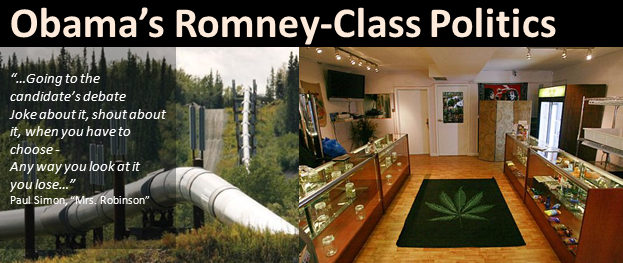
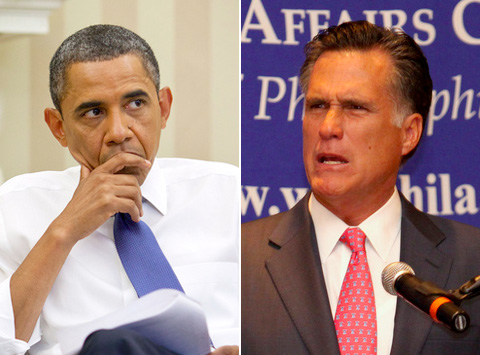
By RAR Mitt Romney is doing a pretty miserable job, in the Republican primaries, of pretending to be a far more right-wing figure than he really is. Conventional wisdom says that playing to those radical elements that show up to cast votes in primaries is a necessary part of what one has to do to win the party’s nomination to run against Obama. In the general election, Romney can drop the uncomfortable playacting and run from his natural political center. His problem has been that he lacks the social flexibility to misrepresent himself convincingly. People see through his clumsy guise, and it causes them to question Romney’s character. Who is he? What is his purpose in running for President? The Romney-despising mainstream press has covered this ad nauseum, which has inflated to threat status of Romney’s otherwise laughable competition for the nomination, particularly Rick Santorum, a true radical. Watching the often amateurish-appearing Republican nomination process might lead one to assume that President Barack Obama has re-election in the bag, but wait. Obama has had his own wandering brand of politics on display as a sitting President for three-plus years, which has caused many of his 2008 supporters to wonder who the devil he is. His popularity surges to 50 percent when he goes on the stump, but for every charisma point he garners, he loses ten by dint of his jaw-dropping folds at the negotiation table. He did it again this week, with the Keystone XL pipeline compromise and his stepped-up efforts to shut down medicinal marijuana dispensaries in states where they operate legally under state law.
2012 Election The Right is Freaking - and Who Wouldn't?
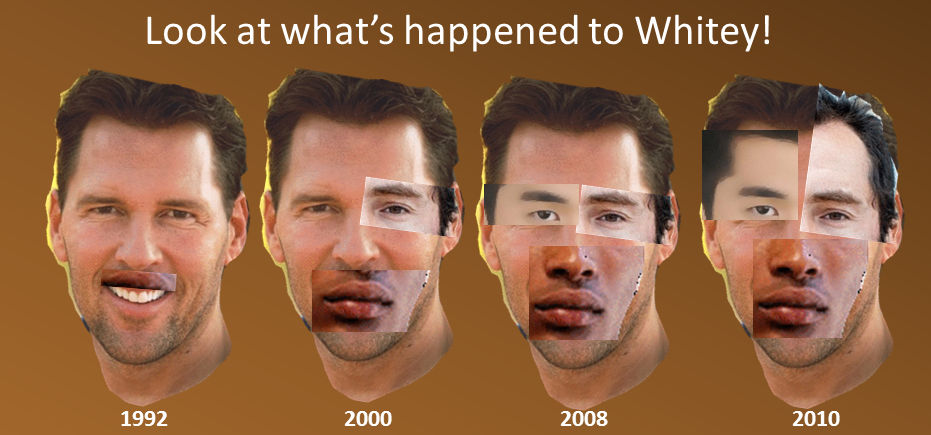
By RAR The Right Wing of the U.S. electorate is freaking out, and as Jonathan Chait wrote recently in New York Magazine the reasons are pretty clear: "America will soon come to be dominated, in a semi-permanent fashion, by an ascendant Democratic coalition hostile to its outlook and interests. And this impending doom has colored the party’s frantic, fearful response to the Obama presidency." The coalition of which he speaks is the growing number of Black, Hispanic and Asian voters who are becoming a larger part of the U.S. electorate profile with each election cycle. The series of composites above, while only roughly representative of the statistical data they are based upon, more or less tell the story of an American voter profile that has undergone significant demographic changes over the last few decades. (If this were a more nuanced graphic it would further indicate the gender divide, which now balances on the side of women.) There was a time when "Whitey", above on the far left, represented almost 85 percent of the voting citizenry. That "Whitey"-dominated vote rather reliably broke down the middle between Republicans and Democrats, with slightly more men tending to vote Republican, and many more women tending to vote Democrat. The Black vote, which was not significant until recent election cycles, since the 1960s has gone heavily Democratic, with an allegiance tied to the era of the Civil Rights movement and the sides chosen by the Republican and Democratic parties at that time. By 2008, the White share of voting power had been reduced to around 76 percent of total, diminished by the growth in minority voting blocks, and spurred particularly by the enthusiasm for the candidate Barack Obama in two typically under-representative demographics: the Black and Youth votes. Both turned out big for Obama in 2008. But then a fascinating thing happened in the 2010 cycle. People in the 18-44 year old voting groups, who had played such a key role in the Obama election, evaporated before the next votes were cast, with vote totals falling from 54.8 million in that age group in 2008 to 31.8 million in 2010. In the cold and deep recession, with jobs scarce and the economy fragile, and with Obama showing little inclination to champion seriously progressive legislation, young people apparently lost all interest in their still-new hero. The result was that rather than youthful progressives calling the dance, 2010 belonged to the extreme other side of the political spectrum, the ultra-conservative, race-resenting, anti-government Tea Party. As Chait astutely observes - "Whatever its abstract intellectual roots, conservatism has since at least the sixties drawn its political strength by appealing to heartland identity politics. In 1985, Stanley Greenberg, then a political scientist, immersed himself in Macomb County, a blue-collar Detroit suburb where whites had abandoned the Democratic Party in droves. He found that the Reagan Democrats there understood politics almost entirely in racial terms, translating any Democratic appeal to economic justice as taking their money to subsidize the black underclass. And it didn’t end with the Reagan era. Piles of recent studies have found that voters often conflate 'social' and 'economic' issues. What social scientists delicately call 'ethnocentrism' and 'racial resentment' and 'ingroup solidarity' are defining attributes of conservative voting behavior, and help organize a familiar if not necessarily rational coalition of ideological interests. Doctrines like neoconservative foreign policy, supply-side economics, and climate skepticism may bear little connection to each other at the level of abstract thought. But boiled down to political sound bites and served up to the voters, they blend into an indistinguishable stew of racial, religious, cultural, and nationalistic identity." Chait goes on the write that panic has set into the Republican Party in this 2012 election cycle and driven it to the hysterical Right. The Republican intellectual class sees the growth in the minority populations and their pro-Democratic voting patterns in apocalyptic terms, with the result being that America, as they have known it, will become swept away by mounting waves of non-White citizens. To panicked Republicans, this equates to overwhelming numbers of poor people, like zombie hordes, coming to pick their pockets. They envision a dependent class and conjure up a trope that has resonated with conservatives since at least the FDR Administration: lazy poor people sponging off the rest of us. This plays right into their paranoid belief that the Democrats, and Obama in particular, are determined to re-create the United States in the European socialist model, which would further cement the unequal relationship between the haves and the have-nots. The asynchronous part is that the Republicans are worried for the haves - or, probably more succinctly put, themselves. House Republican budget chairman Paul Ryan talks about the debate in terms of “makers” against “takers”. “The tipping point represents two dangers,” he told the American Enterprise Institute, “first, long-term economic decline as the number of makers diminishes [and] the number of takers grows … Second, gradual moral-political decline as dependency and passivity weaken the nation’s character.” Ryan and other Republicans have deep doubts that people of color are of the same moral fiber as was Whitey, in his purist form. This canard usually finds as its target the government assistance programs that in the Republican mind benefit "welfare queens" and other gamers of the system, a mythology going back to the Reagan Administration and long before that. It was in the late 1960s when the first signs surfaced that well-intentioned programs to provide low income housing and other anti-poverty programs were yielding unintended and unwanted results. The system struggled along as a black hole money pit for years, draining public will and appreciation for its initial ambitions. Dismantling the welfare system in the U.S. didn't happen until Bill Clinton used the opportunity to create compromise with conservative Republicans in his first term in office, but by then the mythology of America's dependent underclass had become cemented in the minds of the population. Far, far more egregious levels of support were being enjoyed by corporations and wealthy individuals, who were enjoying huge tax loopholes and historically low tax rates on income. There were, and continue to be, enormous subsidies to agricultural businesses and to select industries, and millions passed along through legislative earmarks, but somehow none of that fixed in the public mind as surely as did the image of some poor soul living off food stamps and Medicaid, and picking the pockets of the honest working-class citizen. DOOMED TO FAILURE: The Republican strategy for the 2012 election has been to suppress the minority vote by putting as many obstacles in the way of voting as they possibly can. We have seen a spate of voter ID laws in states under Republican control, which also include efforts to lower the reliably Democratic youth vote. The Republicans have further sought to attack unions to undermine their capacity for turning out Democratic voters on election day. All of these actions are stalling measures. Republicans have stalled legislation for the purpose of killing Obama’s agenda, and to further nurture the Tea Party discontent with Washington that they rode to election victories on in 2010. To what end? As Chait writes - "its last chance to exercise power in its current form, as a party of anti-government fundamentalism powered by sublimated white Christian identity politics." The Republicans are trying to leverage Obama's handling of the economy to remove him from office, and possibly even capture the Senate. This wouldn't turn back history - would not restore "Whitey" to his original self - but it would buy time to make changes that would take at least a decade to undo. The Bush Tax Cuts, were an example of a supply-sider's dream come true, including the built-in argument that anything done to undo that legislation would represent an effort to increases taxes, making it a tough political sell. Chait argues that if the Republicans can just tie the federal government up in knots for another decade, maybe they can by then figure out some way to gain a healthy share of the Black, Hispanic and Asian voter blocks. That is, of course, crazy think for a party driven by "identity politics" - they would need to build bridges of outreach to people about which they are inherently distrustful. But in the end, the Republicans don't have any choice. They need to figure out some way to adjust their agenda to accommodate those of minority interest groups. It really shouldn't be that hard. But first they are going to have to get over this lunatic notion that members of minority groups are somehow remarkably different from themselves, assuming "they" are Whitey. Whitey has to learn that while there are struggling poor folks who need help from assistance programs, no one aspires to be in that situation. Americans of all ethnic backgrounds, for better or worse, want the same stuff, much of it superficial. They want plenty of food, nice homes, nice clothing, good cars, spending money, leisure time and vacations, toys, savings, security, and comfort. And without exception, everyone knows that the only way to get that stuff , as a friend of mine used to say, is by "digging out of the earth, like everyone else". Otherwise put, by developing the skills to do a job that you will then show up for every day and succeed at. These are not ambitions exclusive to White people. People want the stuff that improves their experience with living, and even if Whitey disappears beyond all recognition, motivation in a capitalistic society is not really going to become an issue. The increasing pace of things doesn't really leave a citizen with much choice other than to ride the waves as best one can. Those who fear that the zombie poor are coming for them, with food stamps and welfare benefits, need to grab a flashlight and check under their beds. They need to finally confirm that there is nothing there waiting to get them after everything grows darker. And then, after composing themselves, they need to figure out how to get on with getting along minus all the boogie man hype. 022712 ________________________ Air Force One Snakes On a Plane
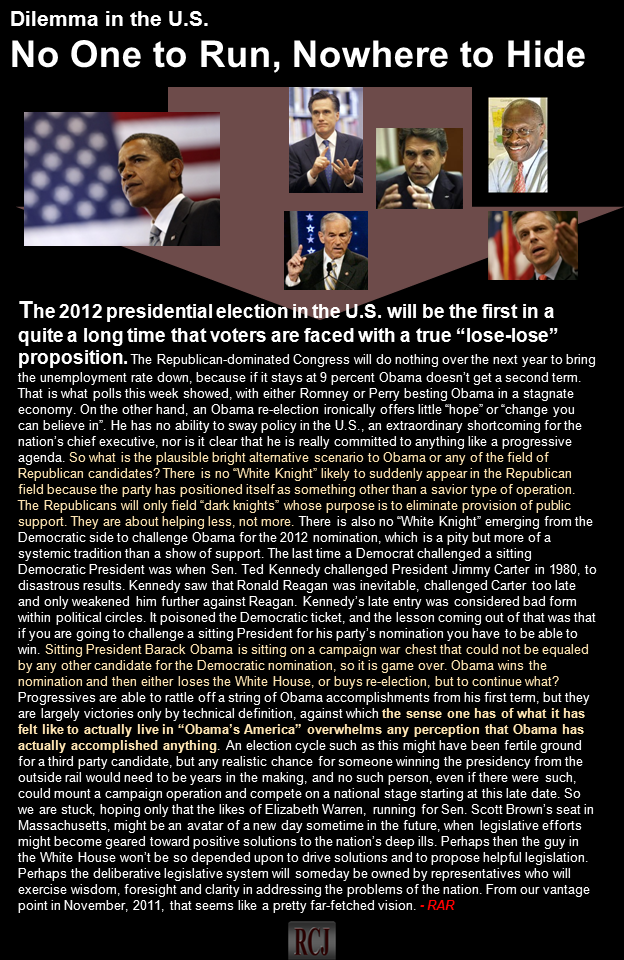
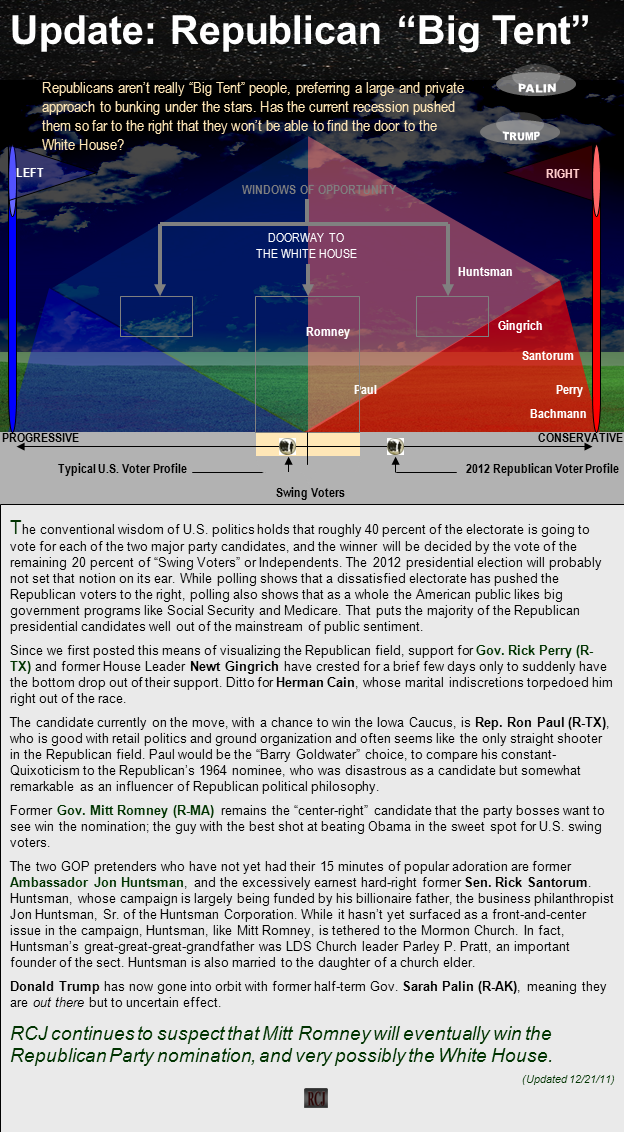
The 2012 Election seems to us at the RCJ to be the most depressing in recent memory, and right at a time when the nation needs fresh hope, too. It is disheartening, but it is also intriguing, even somewhat entertaining if your idea of entertainment is to watch the politics of personal destruction. While the odor of mendacity is a little overwhelming, it does seem darkly satisfying that these TV wars are waged among people who sort of deserve all the ill will that is coming their way, even when it is summoned by the likes of Newt Gingrich in a tantrum fit of internecine warfare. Gingrich's slash and burn style has been the catalyst for a bare knuckles brawl among guys who can't really take a punch. Striking first and throwing questioners off script has been critical to his survival as a candidate, given an uncomfortable personal history that is rather like that of a grifter and deceitful swain. Newt is a delusional egomaniac who truly believes that he should be President of the United States, but he is also an individual of weak character who couldn't actually mount a real run for the office if his wife...excuse me, life depended upon it, which it actually seems to. Newt is the guy for whom wealthy PAC men bought the rights to "When Mitt Romney Came to Town", the 28-minute documentary consisting of interviews with working class people who lost their livelihoods after Romney's Bain Capital private equity firm bought out the companies for which they worked. The documentary, available from our Elections 2012 page, has been derided by Romney supporters as a hit piece, but in truth it is heartbreaking to watch. This is not highly-produced Madison Avenue message making, but rather videotaped conversations with people we know, and possibly are. At this moment in history, it is impossible to imagine that Mitt Romney could be elected dog catcher given his inherited and personal wealth, "vulture capitalism" business history, and his personality shortcomings. And that even after a five-year campaign for the highest office in the land. One wonders, watching Romney gaff his way through routine photo opportunities, if he isn't subconsciously sabotaging his own self, suspecting deep down that he has done many bad things and does not deserve to become president of anything. This 2012 Election is rife with weird factors:
Editor's Note: Add the inability of moderate Jon Huntsman to catch on. Shortly after this piece was published, Huntsman dropped out, his billionaire father apparently not that impressed by Huntsman's third place finish in his home state. ____________________
The Huntsman strategy of presenting the moderate alternative, being more or less inclined to think rationally about scientific and policy issues, and jabbing in debates, rather than dropping bombs, may actually work. At this point, only Mitt Romney can win the Republican nomination, but his date with destiny may be only days away as he faces voters in South Carolina, Florida and Nevada, where unemployment is high and those "King of Bain" characterizations will likely stick. With Romney about to wade into hell, how poetic it might seem to have the upstart Huntsman square off against the high-minded but low-achieving Obama. - RAR (11212) _________________________ Miscalculations of the Right
Republican
Candidates Go Retro with Arguments Shifting Economic Blame
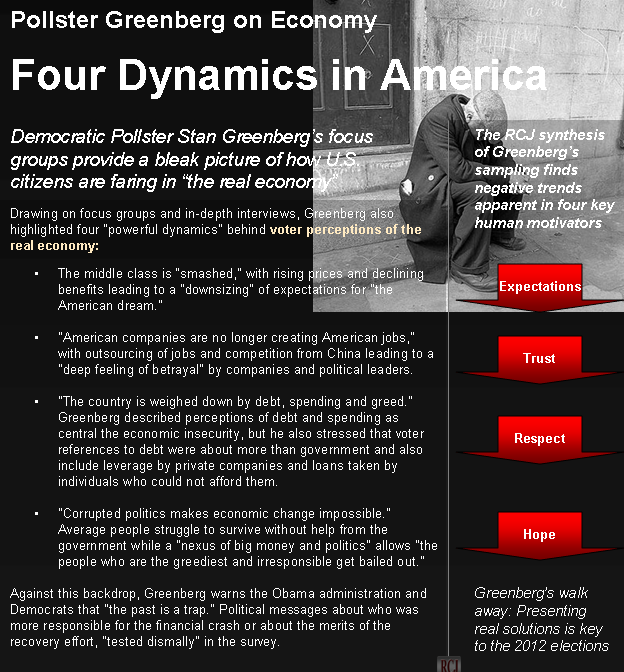
to the Shiftless Poor By RAR Newt Gingrich, whose primary asset is a willingness to use for self-promotion purposes any hyperbole that may pop into his ungoverned mind, was tossing the red meat to the high-spirited crowd attending Fox News Channel's South Carolina Republican debate Monday night (1/16/12). South Carolina is, after all, his last chance to re-establish his unlikely candidacy for the highest land in the office: a late-life attempt at reinvention in pursuit of a job that one suspects he hardly wants. What Gingrich really wants is the level of recognition that he alone believes he deserves; not the kind he got from the ethics investigations and scandals that drove him from the House speakership way back when (1998). Newt wants to be admired and to be paid well for being so. Gingrich is furious at Romney and his Super PAC buddies for running those reminders in New Hampshire of Newt's wayward ways. They seemed almost to deliver a death blow to Gingrich's surprising gains toward becoming a top-tier candidate. Now, in ultra-conservative South Carolina, Gingrich is trying to muscle his way back into contention by going "medieval on their asses", which to a Republican means reaching back for some old nugget from their philosophy of greed and acquisition that has worked for Republican campaigners before. The money-in-the-bank red meat for die-hard Republicans is to blame the country's poor for our economic woes. The poor, goes the refrain, are a drain on a government system that is too large, too invasive and disruptive to the capitalistic system, and that has no business providing welfare in the first place. In fact, the social safety net programs that Republicans label as "welfare" only account for 14 percent of federal government annual spending. These so-called "handouts" include the refundable portion of the earned-income and child tax credits, Supplemental Security Income for the elderly or disabled poor, unemployment insurance, food stamps, school meals, low-income housing assistance, child-care assistance, and assistance in meeting home energy bills, as well as programs that aid abused and neglected children. In "the world according to Newt", the low income population in the U.S. is comprised of slackers who have no history with nor habit of working, nor the inclination to develop in any productive way as long as they are living high on the hog at the government's expense. Newt Gingrich and Rick Santorum, who spins a similar tale of baloney, are both apparently un-curious idiots for were they not they would have looked a little deeper into the problems with our economy, which have next to nothing to do with the social safety net. (Factoid: The Social Security Trust Fund has no problems related to its own sustainability beyond the extent to which it has been raided to pay for other general expenses.) The chart below was developed by the RCJ from Bureau of Labor statistics that are presently showing the U.S. unemployment rate to be at 8.5 percent. This, it is widely understood, undercounts actual unemployment by about half, making it more likely that the current rate is more like 16 percent. Were it to climb over 20 percent, we would be revisiting the conditions of The Great Depression of the 1930s. That 8.5 percent figure is based entirely on the numbers of people who have signed up for unemployment benefits and employment development programs. The Bureau of Labor Statistics recognizes four categories of unemployed workers:
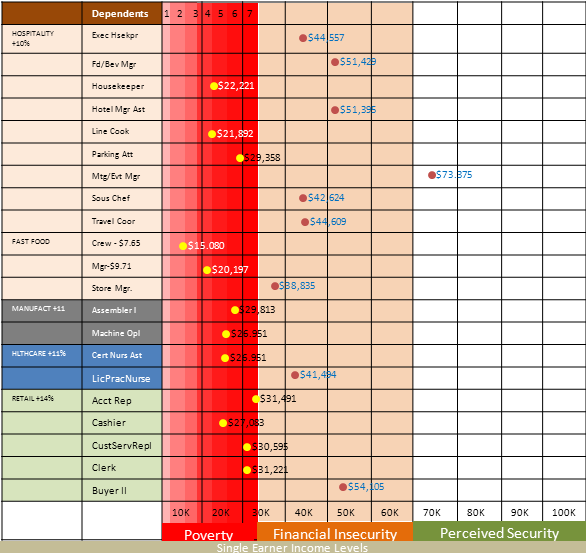
Those percentages are added together to arrive at the 8.5 percent unemployment figure. Just looking at the likelihood of sign-up from unemployed workers in those categories - first-time entry into the workforce, for instance, probably includes only a small percentage of unemployed recent college graduates - gives you a sense for how little these numbers tell us about the overall employment picture. They don't count those people who have exhausted their benefits and are no longer on unemployment, even though they remain unemployed. These workers are often classified as "no longer seeking employment", as if that is an option, though there is a growing population of unemployed who have become "dependents", adding to the income burdens on other relations. (See the chart below regarding dependents and their relationship to "income poverty".) The Right Wing argument that "welfare" is bankrupting the country is undercut by the fact that half of the unemployed population receives no government benefits at all. In fact, while Gingrich goes on about how Barack Obama has been the most-effective "Food Stamp President" of all time, the truth is that only 1 in 5 U.S. families that qualify for Food Stamp assistance actually apply for the benefit. There are a lot of reasons for that, but certainly stigma accounts for part of it. Vicious creeps like Newt Gingrich and Rick Santorum have helped to villainize the most vulnerable of our citizens, effectively denying benefits to people who have probably paid into that social security system and rightly deserve coverage. The Right's argument is that people just need to clean themselves up and go out and get a job. But as this table below shows, America is filled with working poor. THE WORKING POVERTY TABLE We have listed median salaries for various positions in the four "growth sectors" of the U.S. employment picture. We have also indicated the standard the government uses to identify "poverty rates" in the country, which for a single wage earner are calculated against the number of dependents their pay goes to support. A single worker with no dependents must earn more than $10,890 per year to be above the poverty level, and that figure goes up by $3,800 for each dependent he or she supports. That means, according to the national average, a wage earner supporting a family of four would need to earn more than $22,350 per year for his family to be above the Federal Poverty Level. As this chart shows, the kinds of jobs that the workers in those four Bureau of Labor Statistics categories referenced above can realistically get in our current economic environment, often are not sufficient to provide anything like financial stability for them or their family. No one working near the Federal minimum wage level of $7.25 an hour is saving money to go to college, or investing in stocks. They probably don't get health coverage through their employment, and so their wages are not "loaded" in the way that the packages of full-benefit workers are, and for those who have full-benefit packages those are becoming less robust and more dependent upon higher office co-pays. In our contracting economy, those jobs in the Fast Food industry that once provided initial employment opportunities to young people are now often held by older workers with dependents. We are seeing more multi-generational homes, with young adults with children also caring for older relatives under their roofs, adding further burden to their incomes - incomes, by the way, that have been retreating in terms of actual buying power for more than 40 years! Where once just getting a job could set a U.S. worker up with a reasonable expectation of a good life, now it isn't a guarantee of anything. The improvements in the unemployment picture are not even signs of recovery, but are instead driven by hiring of seasonal workers, all of whom will lose their jobs once their seasonal employment ends, and the average worker can expect to then be unemployed for around six months. While workers earning above the poverty level (the red sections below, which are only carried out to seven dependents but can grow much larger) may seem technically stable financially, none of those single wage earners in the brown "Financial Insecurity" zone are saving money or investing in growth opportunities. They are probably trying to keep their head above water with credit card debts, and some may have college loans dragging down their financial outlook for years. They are one cruel surprise away from sliding into the red zone, the poverty trap, where Gingrich and Santorum seem to think people go to kick back.
There is a generally held belief that the $70,000 income level is the "Golden Mean", the juncture at which people begin to exhale and relax. The myth goes that while you can buy more stuff with incomes above $70,000 per year, people don't generally report that their level of happiness increases any with earning above $70K. But even that depends upon where you live. In the San Francisco Bay Area, a family of four living on $80,000 per year would be functionally poor, once you back out the area's living expenses. The Right's diversionary tactic that blames problems on the poor is morally and intellectually false. All that money from government programs that goes to assist the needy is returned directly into the economy, effectuating a straight win-win for the benefit recipient and the public. Grocery stores stay open and crime rates stay capped the way they wouldn't were desperation allowed to hold sway in high-unemployment areas. The welfare that is not necessarily returned to the economy is the corporate welfare that comes from tax deductions and even massive give-backs, often amounting to millions of dollars for well-healed businesses. That money doesn't go back into the system, but it often goes to buy-out other smaller competitors and to tighten the grip on corporate monopolies, which in turn drives down wages and creates the situation we have today, characterized by the disintegration of the American middle class. The greatest error made to date by the Obama Administration has been its failure to reverse the failed policies that have created tax breaks for the wealthy, while pulling back assistance to the poor. The great defining opportunity was this housing crisis, which could have been solved had Obama just chosen to feed the struggling, underwater home owners and forced the mortgage companies to write down absurd principal amounts on loans. All of the big financial and auto bailouts could have been avoided, including the secret billions moved behind the scenes to prop up the charade that this was somehow saving the economy. Obama failed miserably at this moment of opportunity, when America could have been made whole, and now we have the employment (and unemployment) situation we have today. I mean, just study the chart provided here for a moment and consider what it says about our future. While by no means a complete snapshot of our employment reality - it does not include high earning advanced degree holders like doctors, lawyers, engineers, scientists - it is real to the extent that it reflects the majority of America's working-class population, including positions held by the deteriorating middle class. (Updated 12012)________ ELECTION YEAR FEATURE "Any Democrat but Barack!" An RCJ video series on candidates we would like to have considered were the Democratic Party to actually nominate a Democrat in the 2012 presidential election cycle. (We get that they are going with Obama instead, but...)
__________________ Fox News "Democrats" Urge Clinton Run
|
Stop Encouraging Them!What If We Elected "None of the Above"?
By RAR Oh what a weird week in U.S. politics. This was the week in which some of Barack Obama's few high profile surrogates, like Newark, New Jersey Mayor Cory Booker and former Pennsylvania Governor Ed Rendell, went on television and disparaged their own guy's economic policy in harsh terms along the lines of "it makes me sick". Reliable Democratic mouthpieces like MSNBC's Chris Matthews went ballistic, like a guy who suddenly realized that he is on an island with a pariah who few will help to save. DNC Chairperson Debbie Wasserman Schultz isn't even on the stump for Obama, in any consistent way, explaining this week that she had been taking care of her kids and was too busy. The Obama campaign has been positioning this November's election as historic - aren't they all - and a referendum on what America will become in the 21st Century. The implication is that, if the American people turn the reins over to Mitt Romney and the Republican Party, economic disparities in U.S. society will become exacerbated in ways that will render the U.S. unrecognizable from the glory days of the expanding middle class. Just for the record, that expansion ended more than 40 years ago, and we the people have been living on hot air (read "credit") ever since, as our national fortunes have waned through wasteful foreign entanglements, policies of "trickle down" economics, anti-regulation fervor, and outright corruption in high places. You will recall that Obama was elected as an agent of change, but the only change he delivered was his own retreat into a shell of over-compromise that has eviscerated anyone's belief that he is the leader the nation needs at this critical time. On the flip side, Romney doesn't sell himself as an agent of change - a role only the Democrats seem to embrace - but rather an agent of continuity with Republican fiscal and foreign policy. Democrats these days seem to like to use the term "doubling down" when a Republican, even given the obvious results of their destructive economic policy, decides to stay the course, defend the type of economics championed by their hero Ronald Reagan, who in death has become a mythological figure of supply-side economics regardless of the actual damage caused by his philosophical influences. The empty-suit-and-charisma parallels between Reagan and Obama are significant for the vessels each have provided to host the fantasies of their sycophants. Supporters of each, on the other hand, left with few positive tangibles on which to hang their laurels, have exhibited great belief in what they imagine that each politician represents, though Obama in 2012 is a far diminished icon from the Obama of 2008. Liberals can no longer imagine that he is the Messiah, so all that is left is for Democrats is to stick with him because he is of their party. That is not a compelling rallying cry, and it is the reason behind the scarcity of talking heads on TV promoting Obama's re-election. No one, on the Republican side, has much doubt about what Mitt Romney represents: More of the Same. Romney also struggles to get anyone to act as a surrogate on his part, and like Obama his foundational support is all through party affiliations, rather than personal commitment to the candidate. No one seems to personally like Mitt Romney, and Obama seems to have few friends. Both Obama and Romney are in the pockets of the big banks in terms of where their policy allegiances lie.
Diminishing Returns: So why do we keep playing
this game of electoral politics that for generations has
been producing B-grade chief executive officers for the
White House? Given the far right wing politics of the
Republican Party, and the spineless nature of the Democratic
Party, are not all elections now reaffirmation of More of
the Same? More of the Same includes commitment to
voting, because it has been a hard-earned right, but what is
the value of a vote when all options can be understood to be
continuations of what we have seen to be happening, which is
not producing shared wealth?
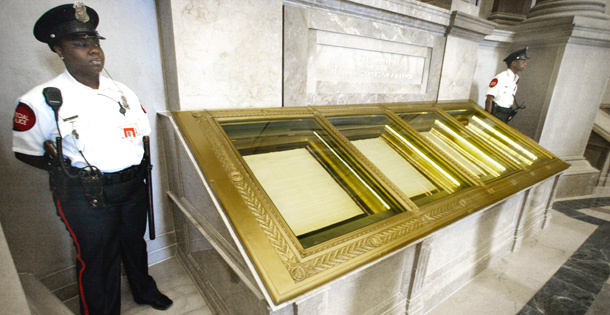
I can feel that, in my lifetime (as I approach 60), things are only going to get worse for average Americans, because as a people we will put off the hard decisions, which include making judgments about sacred cow institutional documents like the U.S. Constitution, which is one of the most historic, but one of the least useful documents in all of human history. (The original is displayed at the National Archives in Washington D.C., photo right.) That rattle-trap compromise, designed in 1776 to protect the privileges of already entrenched interests and now revered by elected officials who yearn to remain elected officials, has produced a constant stream of civil discontent and war that has not been deterred by representative democracy, separation of powers, free speech, gun rights, or even the extension of voting rights, but rather has produced a brand of predation unparalleled in modern human history, including massive incarceration of select groups of citizens, execution of innocent men, mass murder throughout the world, environmental destruction on a global scale, export of dangerous economic schemes, economic disparities exceeding the depravities of Ancient Rome, and finally resulting in the rapid decline of our civilization that we in the U.S. feel today. Checking the Spider-Free Box: What if we put a stop to it by refusing to check the More of the Same box in every election this year, and instead chose to write in None of the Above.
This is what we have been electing and re-electing: maintenance of a web of deceit in which we the voters are the willing victims. That is not working out very well for us, but can we ever, through elective means, defeat the basic killing nature of that systemic web? There is, of course, an order of presidential succession, established by the 25th Amendment to the Constitution and modified several times since its passage, which passes the office through three levels of elected officials before getting into the nominated cabinet positions. The current map of succession goes down 18 places, at that point elevating the Secretary of Homeland Security to the presidency. The upper echelon looks like this:
This all assumes, of course, that there is an administration in place to pass the presidency down through, but what if in November 2012 the American people decide to choose "None of the Above" over either Obama or Romney? One assumes that the presidency would go to the Speaker of the House or, barring that, the President Pro Tempore of the Senate, but what if those offices, too, were left dangling by a "None of the Above" write-in in their elections. This could take out the entire House of Representatives in a single day, including the Speaker of the House, but Sen. Daniel Inouye is in elected office through 2014, which likely means he would become our next president. Only one-third of the Senate will be up for election in November, so that broken body would remain in existence with barely enough membership to host a quorum, as would be required to conduct the business that would elevate the President Pro Tempore to the Office of President of the United States.
Imagine this load of brick landing on the ancient Sen. Inouye, who has already announced plans to run for a 10th six-year Senate term. Unlike Barack Obama or Mitt Romney, Inouye would have earned the honor of becoming President of the United States. As a guy who has given a lifetime of service to this nation, it seems unlikely that he would screw it up, which is a claim neither Obama nor Romney can make, for neither has really done anything with their lives other than take. And both have shown little inclination to do anything other than exploit the systems that make that possible. What if we threw chaos into the mix in November and forced the re-examination of all that is America without the entrenched powers in place to ignore public will and carry on as usual? As a citizenry, we have been taught to fear such a disruptive influence in our political lives. It is in part that fear that keeps us sinking lower and lower into oblivion as a nation of people with voting rights, but without the political courage to exercise the power such a privilege implies. *Daniel Inouye passed away on December 17, 2012. This article was added to this 2012 Election archives in July 2013 ____________________________
"King of Bain" - Part 1 (When Mitt Romney Came to Town) Nasty political rival Newt Gingrich has acquired the rights to this 28-minute documentary about Mitt Romney's private equity firm Bain Capital, which Gingrich will exploit for television ads in South Carolina against nominee-apparent Romney. "The Bain Way" turned the misfortune of others into "striking" personal gains.
"King of Bain" - Part 2 (When Mitt Romney Came to Town)
____________ EDITOR'S NOTE: The threat from Anonymous (below) ran a few weeks before the Iowa Caucus, and the RCJ ran the piece with particular interest. What happened? Anonymous had no apparent presence at all with respect to the Caucus, won narrowly by Mitt Romney. We would admit to real disappointment because the "Expect Us" message was so filled with potential. (11212)
Will Anonymous Show Up at the Iowa Caucus? "Expect Us" Operation Empire State Rebellion - Anonymous calls for shutdown of the Iowa Caucus
|
|
(March 2011) |

|
|
_________ Uncle Sam Wants...Your NeighborhoodObama's Re-Election Dashboard
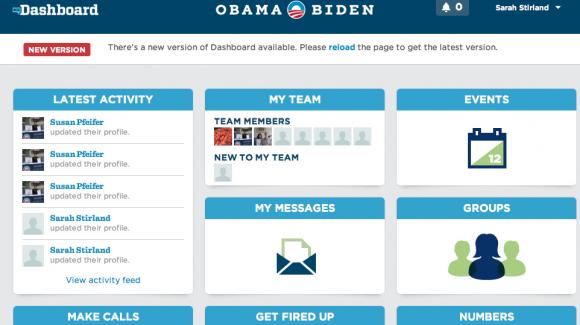
The much ballyhooed Obama-Biden Dashboard was unveiled this week, and for free one can sign up here. One would assume this will make positively certain that you will be pestered from now through election day in November to become more effectively active in campaigning for the re-election of President Barack Obama and his goofy sidekick, Vice President Biden. Getting people elected, or re-elected, is about as un-sexy a calling as a person could possibly endure, which is why you see all of the top echelon veterans eventually get out of the business to become talking heads on cable news as soon as they have established their brands. Whatever the technology, getting out the vote is a grueling contact operation, exactly the same as being a telemarketer or a door-to-door salesperson. All that the new Dashboard does is provides a Web-based way to manage the integration and organization of such operations. Barack Obama has never really stopped being a community organizer, it is just that he now does it through a Web-based organization of surrogates. Dashboard also, somewhat sinisterly to anyone who has concerns about performance based management, measures one individual's effectiveness against that of others in their area. The metrics employed to determine effectiveness relate to categories of contacts, i.e., telephone calls, face-to-face conversations, house parties, special candidate events, media appearances, literature drops, and that type of thing. Electing the President of the United States, at the grassroots organizational level, is exactly the same as selling vinyl siding door to door. The Obama folks are simply leveraging the power of this Web-based organizational tool, along with the social networking sites (Facebook, Twitter, others) to blanket cover the nation's communities with Obama baloney. Dashboard - not a particularly clever name, given that every graphical user interface is called a "dashboard" - was developed by a software company called National Field, which was created by a group who worked on Obama's 2008 campaign and developed that year's version of Dashboard, called my.barackobama.com, which included a function called listServ (in C++, a method in Java). All it did was compile the names of neighborhood volunteers in the area, but it was easy to use and popular, and while it has been incorporated into the new Dashboard product - and National Field has developed Dashboard as a generic product that anyone could purchase for use in managing their outreach operations - there has been early resistance of 2008 supporters to migrate to the new system. They know how to use the old system, which is still available to them outside of Dashboard. And in that they hardly seem like the young turks of social networking who drove Obama to the White House on the strength of their cutting edge technological focus. In fact, the vast majority of them, in a sampling of a San Francisco district, have dropped off the radar altogether and are not participating in the 2012 re-election effort. Those hardliners remaining are apparently a little stuck in 2008, which in technology terms makes them dinosaurs. Change, it turns out, may be something one can believe in, but it doesn't come naturally or easily. In fact, one has to hound people into modifying their behaviors, so one wonders why the Obama-Biden team hasn't explored some clever way to use this rather basic technology to influence from their elected offices. As it is, running for office seems to be all they are really about. - RAR
|
|
Democrats in Transition How Things Have Changed |
||||||||||||
| Right after the elections of 3-plus years ago, Time Magazine did a story on future stars of the Democratic Party. Then along came the 2010 elections and "Tea Party sentiment" and the editors of Time suddenly seemed none too prescient with their racing picks. Their choices may still become national political figures, but right now who among them still has momentum? The RCJ takes a look. | ||||||||||||
| Tainted by her husband's lobbying activities, pushed off the fast track | Swept aside by the Republican tide | As Chairwoman of the DNC she is in a launch pad position | Rolled the dice for Governor and lost huge! What to do now? | Climbing up the ladder to the top of the Democratic Party | ||||||||

|
|
 |
|
|
||||||||
| Stephanie Herseth Sandlin (D-SD) | Patrick Murphy (D-PA) | Rep. Debbie Wasserman Schultz (D-FL) |
Artur Davis (D-AL)
|
Lt. Governor Gavin Newsom (D-CA) |
||||||||
|
|
|
|
|
|
||||||||
| "Prairie Cyclone" | "Iraq Vet" | "Mother" | "Reporter" | "Green Mayor" | ||||||||
| * 40 years old | * 37 years old | * 44 years old | * 44 years old | * 43 years old | ||||||||
| * Married, 1 Child | * Single | * Married, 3 kids | * Married | * Single | ||||||||
| * Lost House seat in 2010 to Republican Kristi Noem after being first woman elected from South Dakota * Comes from political dynasty of former Governor and Secretary of State | * First Iraq vet voted to Congress (2006) but in 2010 lost to former Congressman Mike Fitzpatrick, whom he defeated in 2006 | * Quickly rose to Deputy Whip in the House, youngest subcommittee boss (Cardinal) on the Appropriations Committee | * Was succeded in his Alabama House seat by Democrat Terri Sewell | * Former Mayor of San Francisco | ||||||||
| * Georgetown law * Washington lawyer | * Now an attorney, running for Attorney General of Pennsylvania | * Chairwoman of the Democratic National Committee | * Left House to run for Governor, lost in the primaries | * Harvard degrees, former Federal Judge Clerk and Assistant U.S. Attorney | ||||||||
| * Issues: energy, agriculture, bio fuels and rural access to broadband | * Issues: Veterans, cell phone rights for enlisted, getting out of Iraq, improving federal contracting | * Issues: Child safety | * Harvard degrees, former Federal Judge Clerk and Assistant U.S. Attorney | * Issues: Hybrid automobiles, wind power, government efficiency, public housing, gay rights | ||||||||
| * Reserved personality but firey speaker | * Reputation for tough leadership, intelligence, political savvy, vote counting experience, and fund raising | * Issues: Cuts to public housing programs, protection of Black Belt areas | ||||||||||
(June 2011)
________________________________
|
|
|
©Rick Alan Rice (RAR), September, 2019 |
YOU ARE ON THE
Revolution Culture Journal.com
ELECTIONS
PAGE
Front Page Politics & Policy Technology Media Books Cinema Environmental Design Music Reviews Art Fashion Features Science
Copyright © September, 2019 Rick Alan Rice (RARWRITER)

 So
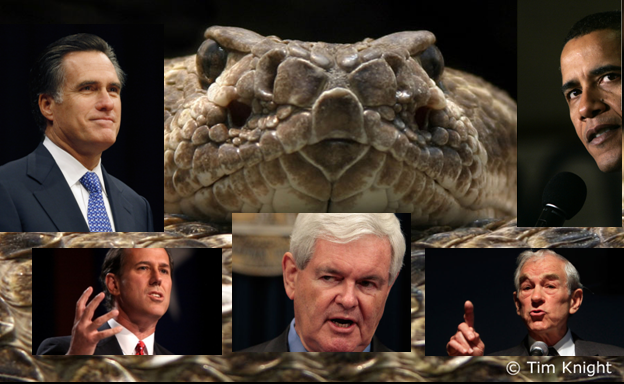
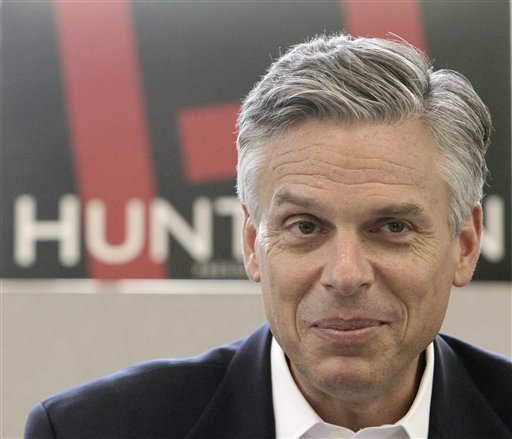
where is this all going? Richie Rich (Jon
Huntsman), there on the left, who managed a third
place finish in New Hampshire, the only state he has
campaigned in so far, and whose PAC money largely comes from
his billionaire father, has been flying under the radar for
most voters who have been more drawn to the flame(out)s of
Bachmann, Perry, Gingrich and Santorum. He may be the most
moderate guy in the Republican field, and possibly the
smartest, though it is hard to read anything from his
record. He was ambassador to China for two years under the
current Obama Administration, and then left that position to
run against his former boss. That storyline seems to have
possibilities that Huntsman, who is a smug and not
particularly adept campaigner, has been unable to exploit.
He was also the Governor of Utah, but he shares the "Mormon
issue" with Romney. He may be helped by the current media
campaign of three of his young-adult daughters, who have
been making the rounds attempting to bring attention to
their low key father. Attractive and energetic, they can
land a Kardashian's-type reality show after the exposure
they are getting in this election cycle. The pitch to the
networks is probably already underway.
So
where is this all going? Richie Rich (Jon
Huntsman), there on the left, who managed a third
place finish in New Hampshire, the only state he has
campaigned in so far, and whose PAC money largely comes from
his billionaire father, has been flying under the radar for
most voters who have been more drawn to the flame(out)s of
Bachmann, Perry, Gingrich and Santorum. He may be the most
moderate guy in the Republican field, and possibly the
smartest, though it is hard to read anything from his
record. He was ambassador to China for two years under the
current Obama Administration, and then left that position to
run against his former boss. That storyline seems to have
possibilities that Huntsman, who is a smug and not
particularly adept campaigner, has been unable to exploit.
He was also the Governor of Utah, but he shares the "Mormon
issue" with Romney. He may be helped by the current media
campaign of three of his young-adult daughters, who have
been making the rounds attempting to bring attention to
their low key father. Attractive and energetic, they can
land a Kardashian's-type reality show after the exposure
they are getting in this election cycle. The pitch to the
networks is probably already underway.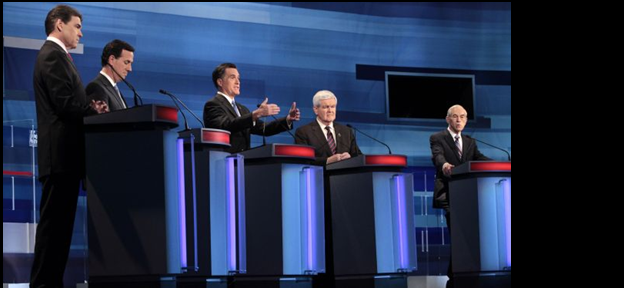

 Web-weaving
spiders are practically omnipotent so long as they have
their sticky killing fields, but take away that web and they
are pitiful and helpless, revealed to be entirely dependent
upon entrapment and ambush.
Web-weaving
spiders are practically omnipotent so long as they have
their sticky killing fields, but take away that web and they
are pitiful and helpless, revealed to be entirely dependent
upon entrapment and ambush.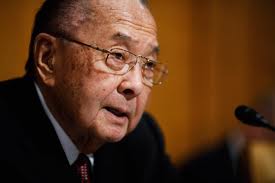 Inouye* is the
chairman of the United States Senate Committee on
Appropriations. A senator since 1963, he is the most senior
senator, the second longest serving U.S. Senator in history
after Robert Byrd. Inouye has continuously represented
Hawaii in the U.S. Congress since it achieved statehood in
1959, serving as Hawaii's first U.S. Representative and
later a senator. Inouye was the first Japanese-American to
serve in the U.S. House of Representatives and later the
first in the U.S. Senate. At age 87, Inouye is the
second-oldest current senator, after 88 year-old Frank
Lautenberg of New Jersey. He is also a recipient of the
United States Medal of Honor, as well as other military
awards.
Inouye* is the
chairman of the United States Senate Committee on
Appropriations. A senator since 1963, he is the most senior
senator, the second longest serving U.S. Senator in history
after Robert Byrd. Inouye has continuously represented
Hawaii in the U.S. Congress since it achieved statehood in
1959, serving as Hawaii's first U.S. Representative and
later a senator. Inouye was the first Japanese-American to
serve in the U.S. House of Representatives and later the
first in the U.S. Senate. At age 87, Inouye is the
second-oldest current senator, after 88 year-old Frank
Lautenberg of New Jersey. He is also a recipient of the
United States Medal of Honor, as well as other military
awards.